Scientists Reveal How Your Brain Reacts When Plans Suddenly Change



A sudden road closure, a canceled meeting, or one changed instruction can force your brain to rethink a plan in seconds. New research from the University of Iowa suggests this is not simply a matter of “trying harder.” When uncertainty appears, the brain’s frontoparietal cortex changes how it communicates with other regions, pulling in the information needed for the next choice. That shifting network may explain why adapting can feel so mentally demanding.
This article was created with the assistance of AI and reviewed by our editorial team for accuracy and clarity.
The Brain Has an Information Hub

The frontoparietal cortex acts like an information hub. It receives signals from across the brain, filters what matters, and helps coordinate a response. Earlier work from Kai Hwang’s team found that it builds a running high-level summary from incomplete or uncertain information. The newer study asked a sharper question: when the rules suddenly change, does this hub simply become more active, or does it change who it talks to?
Researchers Changed the Rules Midstream

To test that, researchers recruited 38 adults ages 18 to 35. Participants learned links between combinations of colors, faces, and scenes and specific button presses using different fingers and hands. Then the researchers changed those pairings. Suddenly, a response that had been correct could become wrong. That forced participants to decide whether the context had changed or whether they had simply missed a cue, creating precisely the uncertainty the team wanted to observe.
Uncertainty Changes the Brain’s Connections
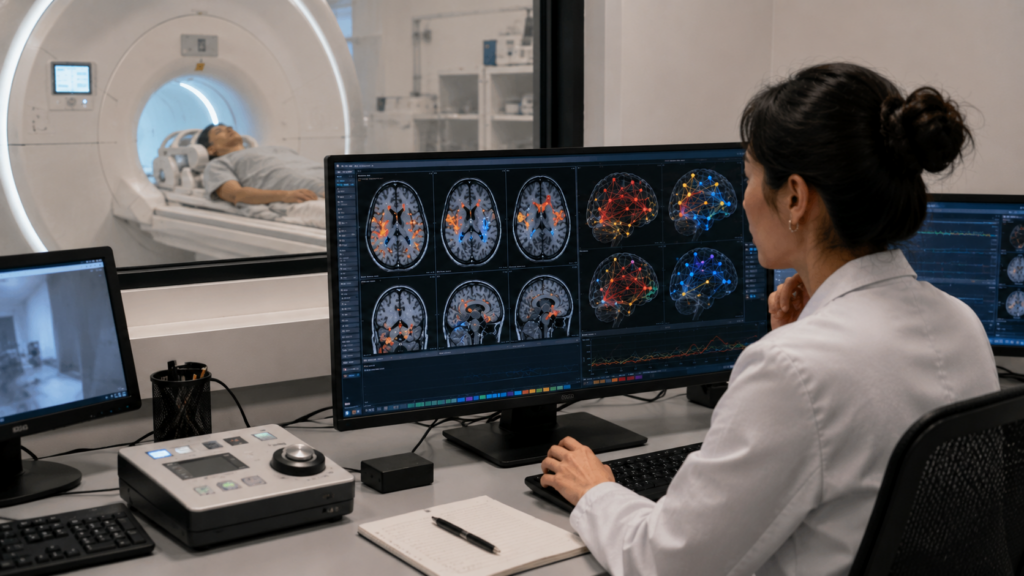
Functional MRI and computational modeling showed that the frontoparietal cortex did not rely on one fixed communication pattern. Instead, its connections shifted depending on what information was useful at each stage of the decision. Hwang said the key contribution was showing what information the hub extracts and how it integrates signals from different brain systems. In other words, uncertainty appears to trigger network reorganization, not just a bigger burst of activity.
Another Study Put Decisions in Motion

A separate 2026 Nature study showed what this flexibility looks like when decisions keep moving instead of changing once. Researchers had 69 adults, including 19 epilepsy patients undergoing brain monitoring, chase moving virtual targets with a joystick. The targets varied in speed, direction, and point value. Rather than locking onto one option, players often divided attention between competing goals, adjusting as the targets moved. That opened a window onto real-time planning.
Three Brain Regions Divide the Work

That study pointed to three brain regions with different jobs. The hippocampus tracked and updated the current plan, especially early in planning. The left anterior cingulate cortex helped determine when to change strategy, while the orbitofrontal cortex supplied information about what was valuable. Together, the pattern suggests that adapting is not a single mental switch. It is a coordinated process of tracking, valuing, and deciding when the old plan no longer fits.
Your Brain May Keep Two Plans Alive

The players also spent a striking amount of time in a “blended” state, splitting focus between targets. When the targets had equal value, this happened 36% to 41% of the time; when values differed, it occurred 37% to 43%. Computational modeling favored a blended control strategy with about 84 percent probability across participants. Instead of choosing one plan outright, the brain could keep two movement plans active and combine them.
Switching Goals Comes With a Cost

Flexibility has a cost, though. In Psychological Review, Ivan Grahek, Xiamin Leng, Amitai Shenhav, and colleagues found that people performed worse when they had to shift between goals such as speed and accuracy, even when the underlying task stayed the same. Their model described “control adjustment costs”: the brain does not instantly arrive at the new mental state. The cost grew when goal differences were larger, adjustment time was shorter, or switches happened more often.
Why Last-Minute Changes Can Feel So Disruptive

This helps explain why a last-minute change can feel harder than it looks from the outside. The research does not say that every frustration after changed plans is a disorder. It does show that shifting goals requires measurable control changes and that uncertainty alters communication between brain systems. The Iowa team says the findings may eventually help researchers study conditions such as ADHD and schizophrenia, where integrating context and regulating behavior can be difficult.
The Next Test Is Everyday Life

The bigger picture is that adaptability is not effortless. The brain appears to revise plans by reallocating information, weighing competing goals, and gradually shifting control states. Scientists still need to test these mechanisms with more complex choices, more uncertainty, and social situations. The Nature researchers also suggest the framework could inform future robots and AI systems that must adjust on the fly. The next question is how well these laboratory patterns hold up in messy everyday life.