Drivers Forced Back to DMV After State Threatens to Cancel 11,000 Licenses Over ‘Irregularities’


Thousands of California drivers who thought their DMV troubles ended the moment they passed their written test are now being told to come back. The California DMV has sent letters to 11,000 licensed drivers, warning that “irregularities” in their test results could lead to their licenses being canceled within 30 days. For drivers who studied hard and passed fair and square, the letter reads like an accusation nobody explained.
Sacramento resident David Specht was one of them. His letter stated his written test results showed “non-compliance with the driver testing criteria required by state law.” Confused, he called the DMV to ask exactly what went wrong. “I know I didn’t cheat,” Specht told CBS Sacramento. “And I presume many of the other 11,000 residents of California who received the letter also didn’t cheat.” No one could tell him why his test was flagged.
The DMV confirmed the affected drivers took their written tests between July 2025 and April 2026. In a statement, the agency said protecting the exam process matters more than convenience. “Ensuring the integrity of our testing process is essential,” the DMV said. “Knowledge tests play a critical role in confirming that drivers understand the rules of the road before they are licensed to drive in California.”
A Letter With No Explanation
For Specht, the lack of clarity only deepened his confusion. When he pressed the DMV for answers, staff admitted he was far from alone. “They said a lot of people received it, we don’t really have an answer for you,” he said. The agency stopped short of accusing him of cheating outright, leaving him to draw his own conclusions about what the flagged results actually meant.
When CBS Sacramento reporter Steve Large asked directly whether Specht believed the DMV was implying he cheated, Specht paused before answering. “I would imagine so,” he said. “I mean, my other thought is that something is wrong with their system on the back end. Maybe they botched some data and now they can’t tell who passed, who failed.” His theory pointed to a deeper problem than individual dishonesty.
Whether the fault lies in flawed testing software or genuine irregularities, the outcome is identical for every driver caught in the sweep. Thousands now face a hard deadline. Retake the written exam within 30 days or watch a valid license disappear, regardless of how it was earned the first time. For many, that deadline is closing in fast, with no guarantee a second attempt will satisfy the state’s unexplained standards.
No Walk-Ins, No Exceptions
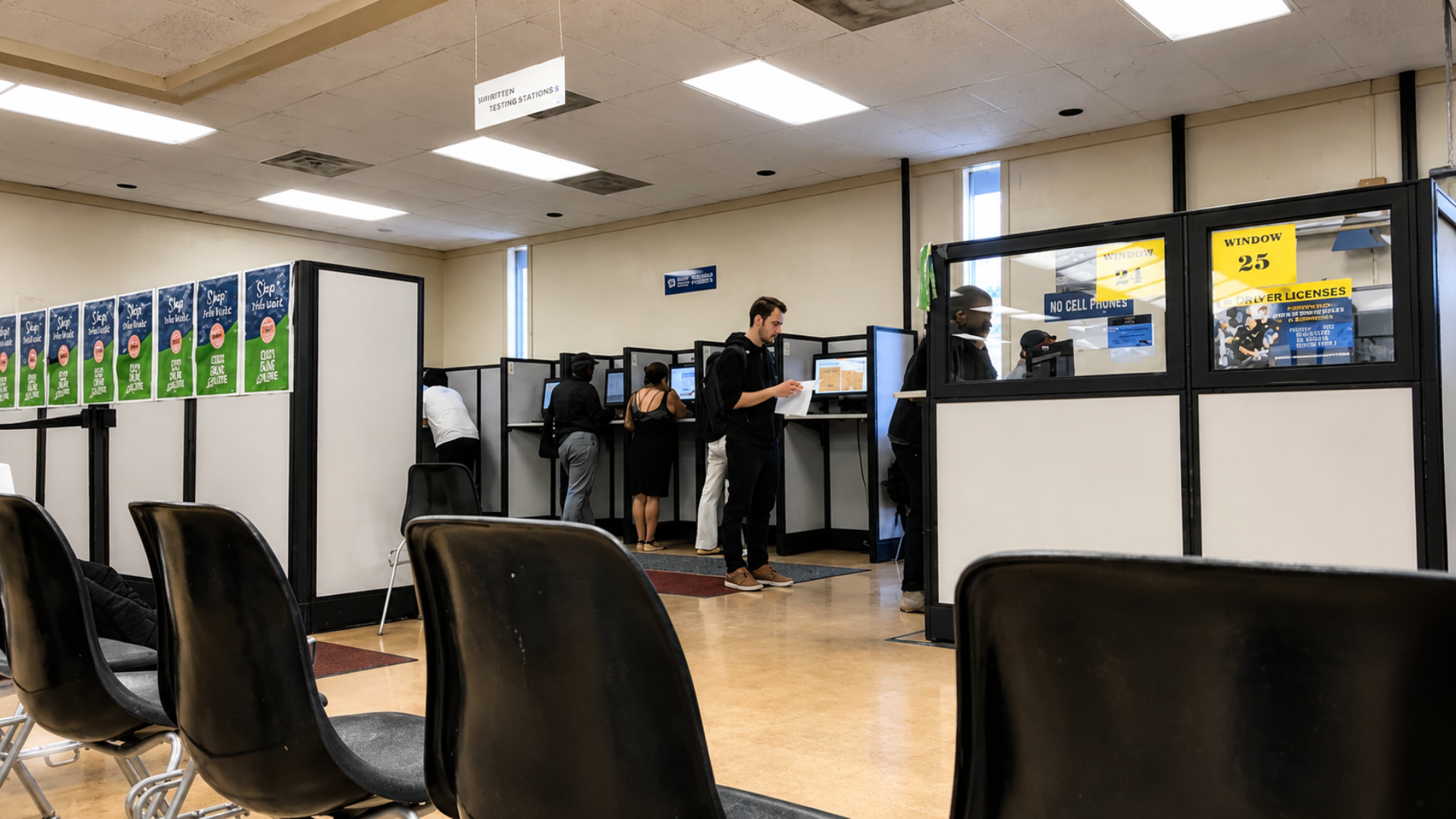
The DMV isn’t leaving room for improvisation. Each of the 11,000 flagged drivers must schedule an official appointment to retake the written test, since walk-ins are not permitted under the new directive. The paperwork requires drivers to bring their original warning letter to the appointment, with no exceptions outlined for those who miss the narrow window. For working parents, students and commuters, fitting a mandatory retest into a tight 30-day window adds pressure to an already confusing situation.
For drivers like Specht, the appointment requirement means rearranging work schedules and childcare, all to retake a test they already passed once. If they fail this time, or fail to show up at all, the consequence is immediate: no license, no legal way to drive to work, school or medical appointments until they pass again. State officials have not said whether drivers who fail a second time will have any avenue to appeal or request a review of their results.
Multiply Specht’s situation by 11,000, and the scale of disruption becomes clear. Retail workers, delivery drivers, parents doing school runs and rural residents with no public transit alternative are all caught in the same net, forced to prove again what they already proved once, without a clear explanation of what went wrong the first time. For many, missing work for an unexpected retest brings a financial cost, plus the stress of not knowing what they did wrong.
Trust on Trial

The DMV’s letter campaign raises a deeper question about accountability. When a government agency admits it flagged 11,000 people for “irregularities” without identifying a single specific cause, the burden of proof effectively shifts onto the very people who did nothing wrong. Drivers are left defending themselves against an accusation the state itself cannot fully explain. For a process meant to confirm drivers know the rules of the road, the DMV’s own opacity has become the biggest source of public frustration.
Specht plans to comply and retake the test simply because losing his license isn’t worth the fight, regardless of whether he believes he cheated. Many of the 11,000 affected drivers are expected to make the same calculation, quietly resubmitting to a process they don’t fully understand rather than risk losing their ability to drive legally in California. It’s a pragmatic choice, but one that leaves the underlying question of what went wrong unresolved for every driver who received the letter.
What began as a routine written test became a lesson in how little explanation a state agency owes the people it regulates. 11,000 Californians passed a test once, only to be told their success might not count. Whatever caused the “irregularities,” the burden of resolving them landed squarely on the drivers themselves, while the system that created the confusion faced no such reckoning.