US Job Market Loses 92,000 Jobs After Hiring Has Slowed Across Industries



For years, the U.S. labor market seemed nearly unstoppable. Even through inflation spikes, global instability, and rising interest rates, hiring kept moving forward. But February’s jobs report delivered an unexpected twist: employers cut 92,000 jobs and the unemployment rate rose to 4.4 percent. The numbers alone tell part of the story, but economists say the deeper shift may have started long before this report arrived.
A Sudden Shock in the Latest Jobs Report

The latest labor market data surprised many economists who expected hiring to remain steady. Instead, payrolls contracted by 92,000 jobs, a sharp reversal from earlier forecasts and a signal that hiring may be cooling more quickly than anticipated. The unemployment rate also ticked up slightly, reaching 4.4 percent, according to the latest jobs report from the Bureau of Labor Statistics. The drop has renewed questions about whether the labor market’s long period of strength may be fading.
Job Losses Spread Across Key Industries

One reason the report drew attention is that the job losses were not confined to a single sector. Manufacturing employment fell by about 12,000 jobs, while construction shed roughly 11,000 positions, according to the Labor Statistics data summarized in reporting on the release. Mining and logging also recorded smaller declines. When multiple industries begin slowing at once, economists often look for broader economic forces behind the shift.
Even Health Care Felt the Slowdown

Perhaps the most surprising part of the report involved a sector that rarely weakens. Health care is typically one of the strongest drivers of employment growth and it lost about 28,000 jobs in February. Part of that decline was linked to a major strike involving Kaiser Permanente workers during the government’s survey period. Still, economists say the slowdown highlights how sensitive the labor market has become to disruptions in even its strongest industries.
Government Jobs Are Quietly Declining

Government employment has also been trending downward, adding another layer to the story. Federal payrolls fell by about 10,000 jobs in February, continuing a longer contraction in public-sector employment. Since its peak in 2024, government employment has declined significantly as agencies adjust staffing levels. During uncertain economic periods, government hiring often helps stabilize the labor market, but this time it appears to be moving in the opposite direction.
The Economy Is Sending Mixed Signals

The jobs report landed amid a complicated economic backdrop. Rising oil prices and geopolitical tensions have raised concerns about inflation and economic growth at the same time. Financial markets reacted quickly, with stocks dipping as investors tried to interpret what the weak employment numbers might mean. The uncertainty has also complicated the outlook for policymakers trying to balance growth and price stability.
The Federal Reserve Faces a Difficult Balancing Act

A weaker job market would normally push the Federal Reserve toward cutting interest rates to support the economy. But inflation risks make the decision more complicated this time. Ellen Zentner of Morgan Stanley Wealth Management said the latest employment figures may have put policymakers “between a rock and a hard place.” In other words, the Fed may have fewer clear options than usual.
A “Low-Hire, Low-Fire” Labor Market

Some economists say the slowdown may reflect a deeper shift in how companies approach hiring. Businesses appear reluctant to expand payrolls quickly while they assess economic risks and the impact of new technologies. Thrivent investment chief David Royal said companies may hesitate to hire aggressively because they are still unsure how tools like artificial intelligence will affect future staffing needs. As a result, the labor market has entered what some analysts describe as a “low-hire, low-fire” phase.
The Job Market Has Been Cooling for Years
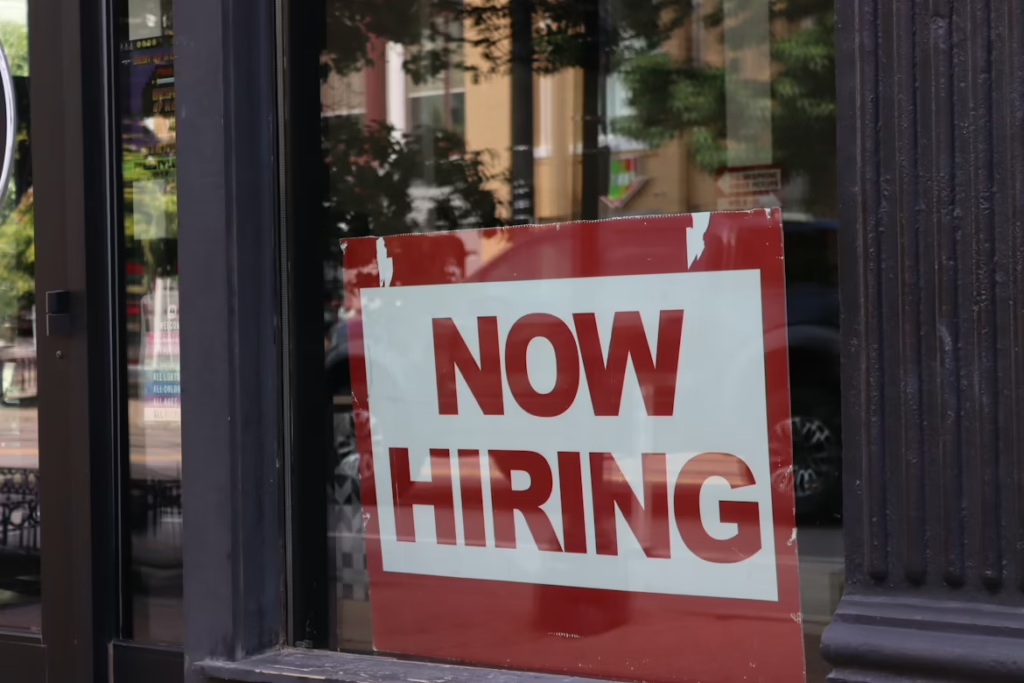
The latest job losses may be part of a broader trend that began after the pandemic recovery boom. ADP Chief Economist Nela Richardson noted that hiring and quitting rates have slowed sharply in recent years. Worker turnover has fallen to one of its lowest levels in nearly a decade, reflecting a labor market where employees and employers are increasingly staying put. Richardson described the shift as a move away from the fast-moving job market of the “Great Resignation” toward one defined more by stability—and caution.
What Comes Next for the U.S. Labor Market?

For now, the February jobs report leaves economists with more questions than answers. The unemployment rate remains relatively low, but hiring has slowed and job losses are appearing across multiple sectors. Some analysts believe the numbers reflect a temporary disruption, while others see the early stages of a broader shift in the labor market. Either way, the next few months of employment data may reveal whether February was an outlier—or the beginning of a new chapter for the U.S. economy.